
The best WordPress plugin for clubs and associations
The best WordPress plugin for clubs and associations is Nonprofit Manager, if you want a member roster, dues collection, a newsletter, and an events calendar in one free system with no per-member fee. The main alternative, Wild Apricot, does the same job as fully hosted software billed by the contact. Here’s how to choose.
How we priced this: every figure below comes from each vendor’s own pricing page, checked in July 2026.
Quick answer
- Best free, self-hosted: Nonprofit Manager
- Best fully hosted, no WordPress needed: Wild Apricot
What running a club or association actually needs
Most clubs and associations need the same short list. A roster of who’s a member. A way to collect yearly or monthly dues. A newsletter to keep people in the loop. A calendar for meetings and events. Nonprofit Manager covers all four for free on the WordPress site you already run. The free version tracks membership status and takes payments, but doesn’t auto-bill a fee the moment someone joins a tier. Nonprofit Manager Pro closes that gap. Set a price per level, and a member who joins through the public join form is charged automatically on that schedule going forward. If a payment fails too many times, the member automatically drops to a fallback level you choose.
Different kinds of clubs, different actual needs
“Club or association” covers a wide range, and the right tool depends on which one you actually run. A hobby club, a bowling league, a book club, a model railroad society, mostly needs a roster and a way to collect an annual fee. Nothing about that requires ongoing per-member billing, and Nonprofit Manager’s free version, plus dues collected as a one-time payment at renewal, covers it completely.
A professional association or alumni chapter usually wants more: tiered membership levels (student, standard, lifetime), automatic renewal so dues don’t quietly lapse every year, and a newsletter that goes out on a real schedule. That’s the profile Nonprofit Manager Pro’s dues auto-billing was built for specifically.
A homeowners association sits in its own category. HOA dues are often mandatory rather than optional, tied to a legal covenant rather than a voluntary membership choice, and the software need is closer to “collect a required assessment reliably” than “manage an opt-in community.” Nonprofit Manager can still collect the payment and track who’s current, but a board handling delinquent-assessment enforcement or lien filings should talk to an attorney about the legal side, since no plugin handles that part.
The options
Nonprofit Manager, best free and self-hosted
Free membership tracking, donations and dues through PayPal, Venmo, and Stripe, a newsletter, and an events calendar, all with no per-member fee. Pro adds auto-billed recurring dues per level through a public join form. It also adds custom member fields for things like committee or chapter assignment, and list imports from a spreadsheet or Mailchimp. Here’s how to collect dues with it.
Wild Apricot, best fully hosted option
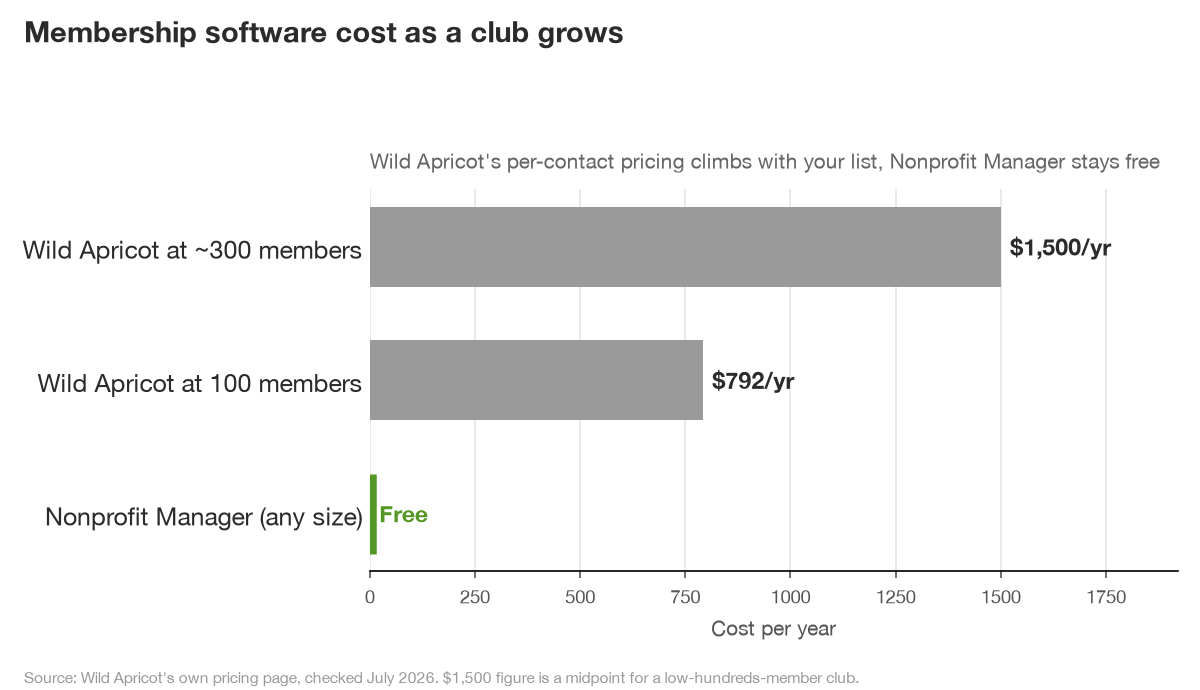
A polished, fully hosted platform built specifically for clubs and associations, starting at $66 a month for 100 contacts, with no WordPress required. It includes an event registration system and a member portal out of the box. The price climbs in tiers as your contact count grows past 100, 250, 500, and beyond. Would rather not run your own site at all, and comfortable with the contact-based pricing? Good fit. Nonprofit Manager compared to Wild Apricot.
What the per-contact fee costs as your club grows
Wild Apricot’s $66-a-month entry tier covers 100 contacts, and most clubs and associations don’t stay at 100 for long. Cross that threshold and the price steps up, commonly landing between $100 and $150 a month for a club in the low hundreds of members. That’s $1,200 to $1,800 a year for membership software alone, before you’ve spent a dollar on the events or programming your dues are supposed to fund. A five-year-old club that started small and grew steadily can easily have paid $5,000 or more in software fees. That’s for a job Nonprofit Manager does for free on hosting you’re already paying for.
Setting up automatic dues billing
With Nonprofit Manager Pro, this is a one-time setup. Pick a membership level, set a price and billing frequency (monthly, quarterly, or yearly), and turn it on. A new member fills out the public join form, pays through Stripe, and their dues subscription starts automatically from that point forward. No one on your board has to remember to invoice anybody.
Failed payments count toward a threshold you set, three attempts by default. Once that’s reached, the member automatically drops to a fallback level you choose, instead of staying active on a card that stopped working. Your roster ends up reflecting who’s actually paid, not who paid once, years ago.
Switching from Wild Apricot
Wild Apricot lets you export your full contact database, including custom fields and event history, as a CSV from its admin settings. Nonprofit Manager’s import wizard reads that file and maps the columns to its own member fields. It skips any row that already exists by email address, so re-running the import partway through doesn’t create duplicate members.
Recurring dues charged through Wild Apricot’s own payment processing don’t transfer automatically. Set up the matching levels in Nonprofit Manager Pro’s dues auto-billing first, and get members re-enrolled there, before canceling anything on Wild Apricot’s side. That overlap, usually one billing cycle, means no member’s dues lapse during the switch. It also gives your board a chance to confirm the new setup actually works before the old one goes away for good.
One thing Wild Apricot handles that a fresh WordPress install doesn’t: a member-facing website out of the box. If you’re switching away from Wild Apricot specifically because you already have a WordPress site, this is a non-issue. If you don’t yet have one, budget time to get a basic site running before you make the leap.
Our pick for the best plugin for clubs and associations
Already have a WordPress site, or don’t mind setting one up? Nonprofit Manager gets your club running for free with no monthly bill that grows with your membership. Pro adds auto-billed dues at a flat price if you need them. Want zero technical setup and fine paying by the contact? Wild Apricot is a reasonable, well-built alternative.
Compare by category
See how Nonprofit Manager stacks up in other areas:
- Best WordPress plugin for donations
- Best membership plugin for nonprofits
- Best WordPress plugin for nonprofits
- Best newsletter plugin for nonprofits
- Best WordPress plugin for churches
Frequently asked questions
Can I collect membership dues through WordPress?
Yes. In the free version, you accept dues as a one-time payment through PayPal, Venmo, or Stripe and mark the member active at that level. Nonprofit Manager Pro goes further and auto-bills dues on a schedule through a public join form.
Is there a per-member fee?
No. Nonprofit Manager’s core has no per-member or per-contact fee, unlike hosted platforms such as Wild Apricot that charge more as your membership grows.
Can dues billing automatically downgrade a member who stops paying?
Yes, in Nonprofit Manager Pro. Set a failed-payment threshold, three attempts by default. Once it’s reached, the member moves to a fallback level you choose instead of staying active indefinitely.
Does Nonprofit Manager work for a club that doesn’t charge dues at all?
Yes. Membership tracking, the newsletter, and the events calendar are all free and useful on their own, whether or not you ever collect a payment.
Can I import our existing member list from a spreadsheet?
Yes. The built-in import wizard reads a CSV, maps the columns to Nonprofit Manager’s fields, and skips duplicate rows by email address.
Does Wild Apricot’s price include event registration?
Yes, Wild Apricot bundles member event registration into every plan. Nonprofit Manager’s events calendar is free in both the free and Pro versions, listing upcoming and past events. It’s a calendar rather than a paid-ticketing system.
Prices are from each vendor’s official pages as of July 2026 and can change.